
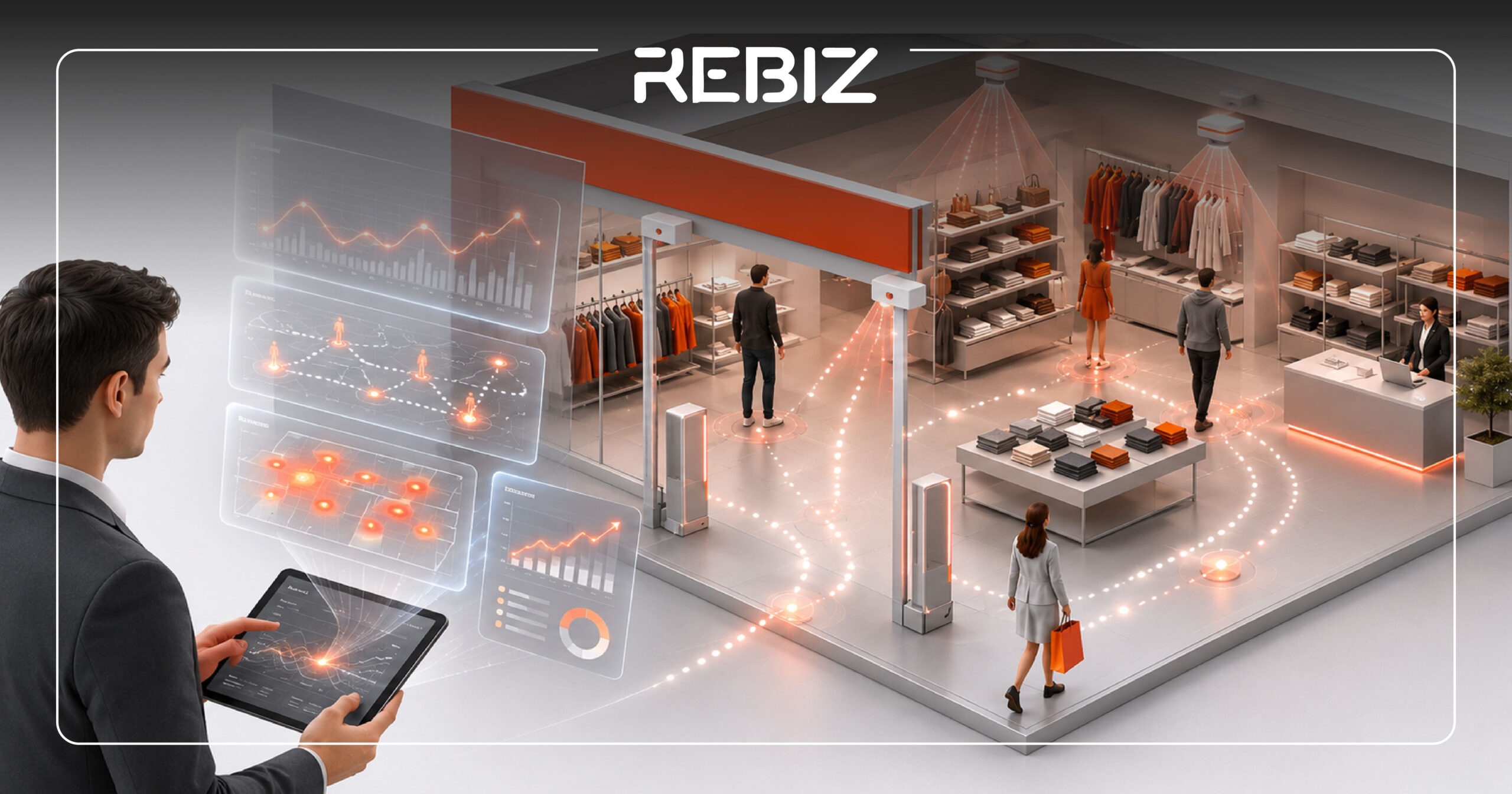
Most multi-unit operators already have a store traffic counter installed. The question is not whether traffic is being measured. It is whether it is being used. Traffic reviewed weekly in a summary report is a lagging indicator.
Traffic connected to rep presence, conversion, and staffing decisions is an operating input. The difference between the two lies in where most of the performance gap lives.
Key Overview
- Most retailers underuse store traffic counters as daily performance tools.
- Foot traffic alone lacks validation, rep assignment, and execution visibility.
- Customer-only traffic enables accurate conversion and gross profit benchmarking.
- Rep-level tracking links traffic to staffing, coaching, and accountability.
- AI-driven forecasting and monitoring turn traffic data into revenue impact.
What Is a Store Traffic Counter (and What Most Retailers Miss)
A store traffic counter measures how many people enter a retail location. Retailers use it to calculate conversion by comparing visits to transactions. On its own, it tracks volume. It does not explain performance, staffing effectiveness, or employee-level results.
Most retailers stop at the count.
They do not validate traffic.
They do not isolate customer-only visits.
They do not connect traffic to rep-level execution.
The counter measures movement. It does not measure selling opportunity unless the data is cleaned and applied correctly.
Why Footfall Data Alone Doesn’t Drive Growth
Retailers increase sales when traffic data is tied to conversion tracking, employee-level performance, staffing alignment, and daily operational visibility. Traffic shows opportunity. Performance improves when opportunity is assigned, measured, and acted on.
Retail foot traffic analytics are often treated as marketing metrics. In-store performance is where the financial impact occurs.
If traffic goes up and conversion drops, something changed inside the store.
If traffic stays flat and profit increases, execution improved.
Traffic without execution visibility does not change outcomes.
7 Practical Ways to Use Traffic Data to Grow Retail Performance
These are operating disciplines used in multi-unit retail environments.
1. Measure True Conversion, Not Raw Footfall
Most stores calculate conversion using total entries.
That includes employees, vendors, children, delivery drivers, and repeat visits.
Customer-only traffic changes the denominator. ReBiz supports visually verified traffic that excludes employees and non-buyers.
Once traffic reflects actual selling opportunity, conversion becomes a meaningful performance metric across stores and reps.
2. Separate Idle Time from Missed Opportunity
Low traffic hours are normal.
Unattended customers are not.
Daily counts of unattended traffic and idle hours show when customers were present but not engaged. ReBiz monitors unattended traffic and store-level idle periods.
This changes how managers interpret slow days. It clarifies whether demand was low or execution was weak.
3. Align Staffing to Demand Patterns
Can footfall data improve staffing and conversion?
Yes. When traffic patterns and rep-level conversion rates are combined, staffing can be aligned to projected demand and performance levels.
Many stores use static schedules.
ReBiz leverages projected traffic data and individual rep conversion rates to recommend optimized staffing levels.
Top performers are placed in front of the highest volume and quality of traffic. Payroll waste is reduced during slow periods.
4. Benchmark Stores Using Gross Profit per Traffic
Total sales comparisons are misleading without context.
Traffic-normalized metrics allow real benchmarking across locations.
In a multi-store study, approximately 60% of stores improved conversion within 90 days of implementing verified traffic and rep-level reporting, with an average increase of 4.29 points.
Gross profit per traffic increased in more than half of locations during the same period.
When opportunity is consistent, execution differences become visible.
5. Track Rep-Level Conversion
Store-level conversion hides variability.
Individual rep performance often varies significantly over time and between employees.
ReBiz assigns traffic to the sales rep who handled the interaction and reports individual conversion rates.
This supports informed coaching, scheduling decisions, and performance accountability.
6. Monitor Store Readiness Daily
Traffic is opportunity. Store readiness determines whether that opportunity is captured.
ReBiz verifies opening and closing times, identifies empty stores, and monitors employee presence against expected schedules.
Late openings and unstaffed periods directly affect revenue potential. Without daily visibility, those losses are absorbed silently.
7. Forecast Traffic Instead of Reacting to It
Retail demand follows patterns.
Historical traffic data supports projection by day and hour.
ReBiz incorporates projected traffic to inform staffing recommendations.
Forecasting supports preparation. Preparation supports conversion.

Where Traditional Traffic Counters Fall Short
A standalone store traffic counter provides volume data.
It does not:
- Validate customer-only visits
- Assign interactions to specific employees
- Track unattended traffic
- Verify store operating compliance
- Connect traffic to scheduling decisions
Many retailers already have hardware in place. The limitation is not the sensor. It is the absence of an integrated performance system.
People counting in retail is useful. It is incomplete without execution visibility.
How AI Turns Traffic into Daily Store Decisions
AI expands what can be tracked consistently across locations.
ReBiz uses Supervised AI combined with human validation to increase tracking depth while maintaining data accuracy.
This supports:
- Verified customer-only traffic
- Rep-level interaction tracking
- Daily monitoring of unattended customers
- Projected traffic forecasting
When alerts, rep-level metrics, and verified traffic arrive daily, managers spend less time pulling numbers and more time acting on them.
From Traffic Data to Revenue: The ReBiz Approach
ReBiz is not positioned as a traffic counter.
It is a retail sales and operations system built around verified data.
The system connects:
- Customer-only traffic
- Rep-level sales conversion tracking
- Interaction time and unattended traffic
- Daily store monitoring
- AI-informed scheduling recommendations
Traffic becomes meaningful when it is assigned, validated, and tied to execution.
Retailers evaluating store analytics tools often begin with footfall tracking retail solutions. Performance improvement requires a system that connects traffic to people, process, and daily action.
See how top operators use traffic data daily.
Request a demo to evaluate how verified traffic and rep-level visibility compare to your current reporting structure.

FAQ
1. What is a store traffic counter?
A store traffic counter is a system that measures how many people enter a retail location. Retailers use it to calculate sales conversion by comparing foot traffic to transactions. More advanced systems validate customer-only visits and connect traffic data to employee performance and operational visibility.
2. How do retailers use foot traffic data to increase sales?
Retailers use foot traffic data to measure true selling opportunity, track conversion rates, and identify performance gaps. When traffic is connected to rep-level performance, staffing decisions, and unattended customer tracking, it becomes a tool for improving daily execution and revenue.
3. Can traffic data improve staffing and conversion?
Yes. When historical traffic trends are combined with individual rep conversion rates, retailers can align staffing with demand. This ensures top performers are scheduled during peak traffic periods and reduces overstaffing during slow hours, improving both conversion and payroll efficiency.
4. What are the limitations of traditional people counting in retail?
Traditional people counting systems often include employees, repeat visitors, and non-buyers in total traffic counts. They typically do not assign traffic to individual employees, track unattended customers, or connect traffic data to scheduling decisions. Without this context, traffic remains a reporting metric rather than a performance driver.
5. How does AI improve retail foot traffic analytics?
AI improves retail foot traffic analytics by validating customer-only traffic, identifying unattended customers, tracking rep-level interactions, and supporting traffic forecasting. When combined with human oversight, AI-driven systems help retailers turn traffic data into daily operational decisions that impact sales and profitability.

