
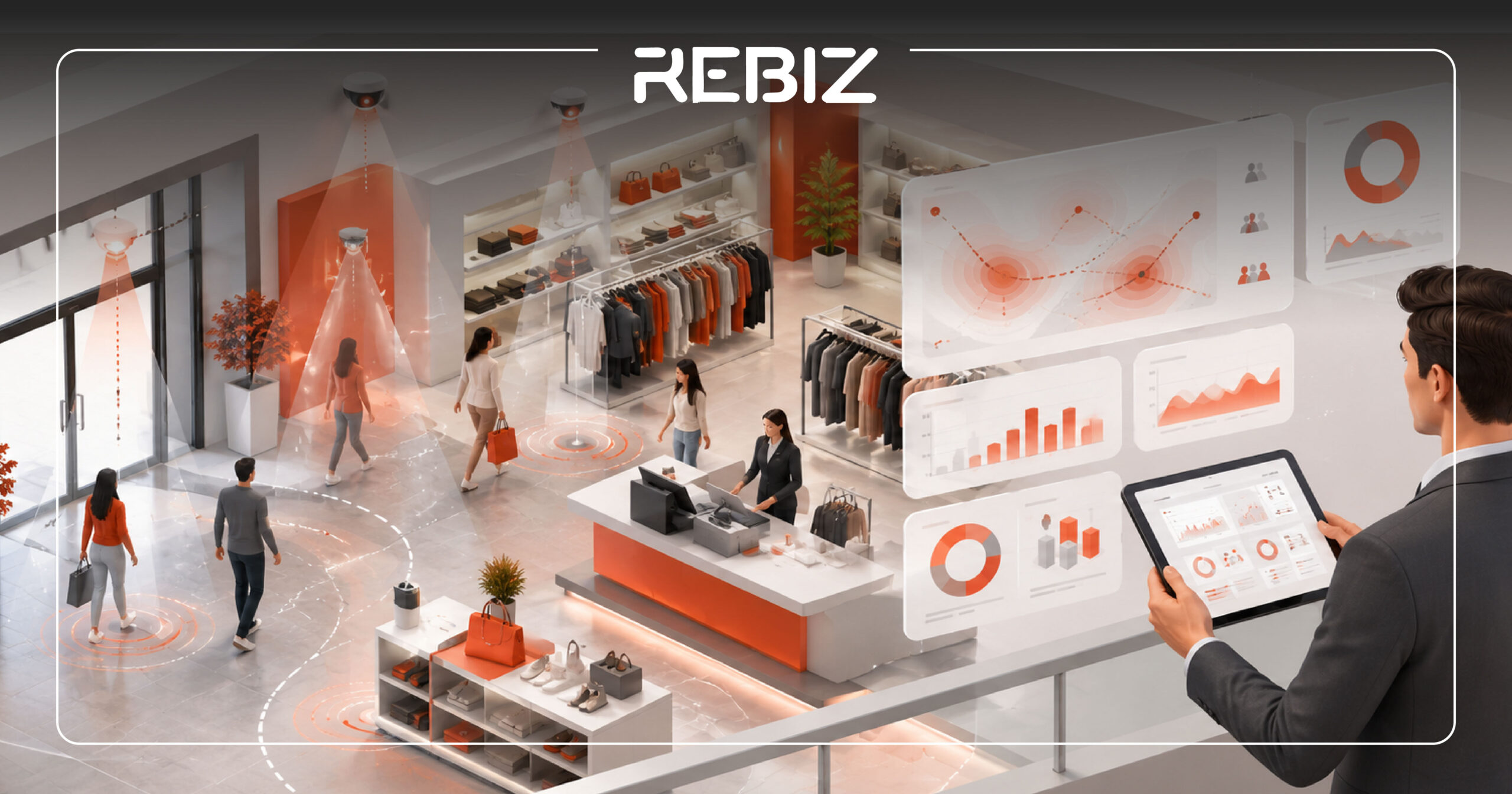
Retail people counting should do more than tally door swings. In multi-unit retail, raw counts include employees, vendors, and repeat entries, inflating traffic and distorting conversion rates. When staffing, coaching, and performance reviews rely on inaccurate traffic, decisions miss the mark.
ReBiz turns retail people counting into verified customer-only traffic, filtered and connected to POS and rep presence. That creates a defensible denominator for conversion, fair store comparisons, and clearer rep-level performance. Traffic stops being a dashboard number and becomes a daily sales lever tied directly to gross profit and accountability.
What Is a Store Traffic Counter (and What Most Retailers Miss)
A store traffic counter or a retail people counting software is a device or software system that records the number of people entering a retail location during a given time period. Most use infrared sensors, cameras, or door-mounted hardware. The output is a count. What operators do with that count is where most of the value and most of the gap live.
Here is what the count does not tell you on its own: whether those entries were real customers, what your reps did with the opportunities they created, whether the right staff were on the floor when they walked in, or why one store converted at 28% and another converted at 6% on the same Saturday.
Most retailers install a counter, watch the trend line, and leave it there. The operators who pull ahead are the ones who treat the count as a starting point, not a finish line.
Why Footfall Data Alone Doesn’t Drive Growth
A traffic number sitting in a dashboard is a metric. A metric without a decision attached to it is overhead. And in multi-unit retail, overhead compounds fast.
The problem is structural. Standard traffic counters measure door swings, not customer opportunities. They count employees arriving for shifts, delivery drivers, the manager who stepped out for coffee and came back, and repeat entries from the same person. That inflated number then feeds conversion rate calculations, staffing models, and performance reviews. Everything built on top of it is calibrated against a denominator that was wrong to begin with.
The retailers who use traffic data well do not just track more. They connect the count to the decisions that depend on it: staffing, coaching, compliance, and conversion. The sections below show what that looks like in practice.
How to Use Traffic Data to Grow Retail Performance

Each of the following is less a “hack” than a shift in operating principle. The gap between what most retailers do and what high-performing operators do is usually not a technology gap. It’s a decision gap.
1. Measure True Conversion, Not Just Footfall
WHAT MOST DO:
Divide POS transactions by total door swings. Report the number. Call it conversion.
WHAT HIGH PERFORMERS DO:
Filter out employees, deliveries, and operational noise first. Customer-only traffic is the correct denominator. A store showing 38% conversion on raw traffic may actually be converting 62% of real shoppers, or 19%. The math only matters if the starting number is right.
2. Identify Dead Hours vs Missed Opportunities
WHAT MOST DO:
Look at low-traffic hours and assume nothing can be done. Reduce staffing to match.
WHAT HIGH PERFORMERS DO:
Separate genuinely low-demand windows from windows where traffic existed but conversion collapsed. A slow Tuesday at 2 p.m. is a staffing decision. A Saturday at noon where traffic peaked and conversion dropped 18 points is a coaching conversation waiting to happen.
3. Staff Against Verified Demand, Not Roster Templates
WHAT MOST DO:
Build schedules based on last week’s roster, manager instinct, and contractual minimums.
WHAT HIGH PERFORMERS DO:
Align schedules to verified customer demand by hour and day. When the traffic data is customer-only and linked to historical conversion by shift, the schedule stops being a template and becomes a performance lever. The stores that overstaff slow windows and understaff Saturday peaks are usually working from dirty data.
4. Benchmark Store Performance Across Locations
WHAT MOST DO:
Compare stores by total sales. Flag the ones at the bottom. Schedule a call.
WHAT HIGH PERFORMERS DO:
Control for traffic. A store doing $40K per month in a low-traffic location with clean conversion is performing better than a store doing $60K on the back of twice the footfall. Traffic-adjusted benchmarking finds the real outliers, the ones hiding behind volume and the ones being held back by circumstances the rep cannot control.
5. Track Rep-Level Conversion, Not Just Store Averages
WHAT MOST DO:
Review store-level numbers. Coach the store. Hope the message reaches the right person.
WHAT HIGH PERFORMERS DO:
Connect traffic data to rep presence and POS outcomes. Which rep was on the floor during which customer opportunities, and what did they do with them? Rep-level conversion data changes the coaching conversation from general to specific, and from defensive to evidence-led.
Explore our breakdown of the 5 Top-Rated Retail Traffic Counters You Can’t Miss in 2026 to compare leading retail people counting solutions and understand how each measures foot traffic across multi-unit environments.
Where Traditional Traffic Counters Fall Short
Traditional retail people counting systems were built to count entries. They were not built to validate selling opportunity or drive store-level decisions.
- No context. A count without connection to POS, staffing, or rep data is a number that cannot answer a business question.
- No filtering. Raw door swings include everyone who walked through the door. Customer traffic is a subset of that and in most multi-unit environments, the subset that actually matters.
- No integration. The count lives in one system. Sales live in another. Schedules in a third. No single picture surfaces without pulling them together manually, which most teams do not have bandwidth to do daily.
- No decision layer. The output is a dashboard. Dashboards require interpretation, and interpretation requires time that district managers running 20 stores do not have.
Most operators realize the limitation is not the hardware. It is the absence of verified, connected, actionable retail traffic analytics.
From Traffic Data to Revenue: The ReBiz Approach
Retail people counting should not stop at measuring foot traffic. In multi-unit retail, traffic only becomes valuable when it reflects verified customer-only counts and connects directly to sales performance.
ReBiz transforms retail people counting into a revenue engine. Using existing camera systems and Supervised AI, ReBiz filters out employees, vendors, and repeat entries to deliver true customer traffic. That verified traffic then connects to POS data and rep presence, producing accurate retail conversion rates at the store and individual rep level.
District managers gain visibility into which locations are underperforming relative to real customer opportunity, where staffing does not align with traffic patterns, and which reps need coaching based on defensible data.
Retail people counting becomes more than a dashboard metric. It becomes the foundation for traffic-adjusted benchmarking, AI-informed scheduling, and daily operational monitoring across every location.
The result is measurable improvement in retail conversion, gross profit per traffic, and payroll efficiency. The traffic count remains the starting point. Revenue impact is the outcome.

FAQ
1. What is retail people counting?
Retail people counting measures how many individuals enter a store within a specific time period. Advanced systems go further by identifying customer-only traffic, providing retailers with a clearer view of true selling opportunities.
2. Why is retail people counting important for conversion rates?
Retail people counting provides the denominator for calculating retail conversion rate. When traffic is verified and customer-only, retailers can accurately measure performance, benchmark stores fairly, and identify gaps in sales execution.
3. How accurate are retail people counting systems?
Accuracy depends on the technology used. Basic door counters often overcount entries. Retail people counting solutions that use video analytics and supervised validation deliver more reliable customer-only traffic data.
4. Can retail people counting filter out employees?
Yes. Advanced retail people counting platforms can distinguish employees, vendors, and repeat entries from real shoppers. Filtering non-customers ensures traffic data reflects actual revenue opportunities.
5. Does retail people counting integrate with POS systems?
Modern retail people counting systems can integrate with POS data to calculate conversion rates, gross profit per traffic, and rep-level performance, transforming traffic data into actionable retail analytics.
6. How does retail people counting improve staffing decisions?
By analyzing traffic trends by hour and day, retail people counting helps operators align staffing levels with verified customer demand, reducing payroll waste and improving coverage during peak selling windows.
7. Is retail people counting useful for multi-unit retailers?
Retail people counting is especially valuable for multi-unit operators who need consistent traffic-adjusted benchmarking across locations, ensuring performance comparisons reflect true customer opportunity rather than raw volume differences.
8. What should retailers look for in a retail people counting solution?
Retailers should prioritize customer-only traffic validation, POS integration, rep-level conversion tracking, and multi-location reporting to ensure retail people counting drives measurable improvements in sales and profitability.

