
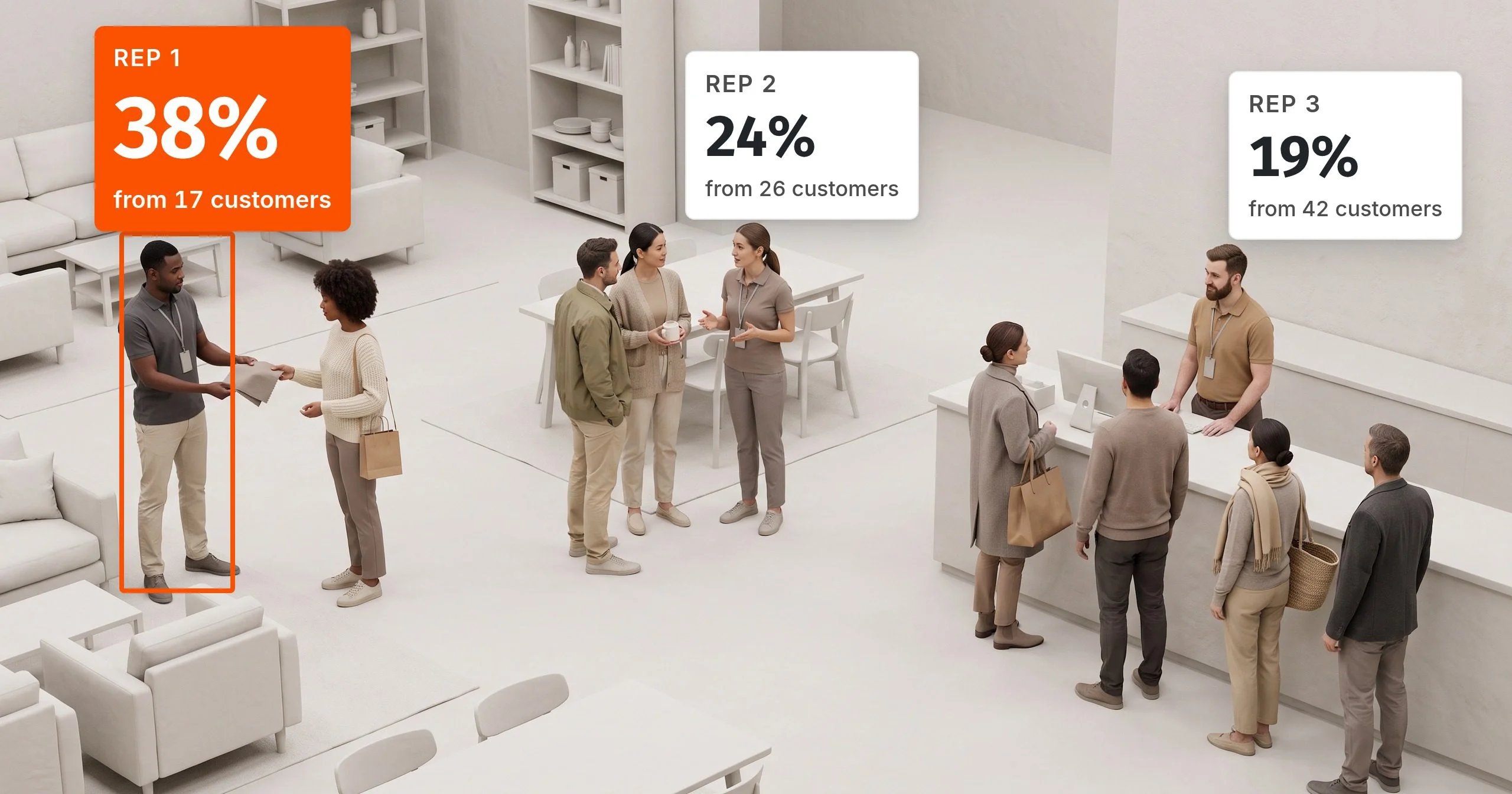
Key takeaways
- Most retail comp rewards looking busy over producing, largely because the data under the plan is dirty
- Performance-based pay rewards verified output: each rep’s customer-only traffic and actual conversion, not proximity or tenure.
- Clean, rep-level data protects your best people and boost business: $8,247 GP/store/mo in one case
Performance-based pay in retail only works if you can measure what each rep actually produces. Most multi-unit retailers try anyway, and the comp plan ends up rewarding the reps who look busy over the reps who actually convert. The root cause is in the data…clean that up and paying for real production stops being guesswork.
In one recent review, 13% of clock-in punches didn’t match actual in-store presence. More than one shift in eight was paid on a false assumption that someone was on the floor in the first place.
Having real visibility into what’s going on in the store is critical for any performance-based-pay plan, so you can compensate reps using real, reliable data.
This is the promise behind performance-based pay, sometimes called pound-for-pound comp: reward reps for what they actually put on the board, measured on data clean enough to defend to the person who didn’t win the spiff. Q3 is comp-planning season for a lot of operators, so it’s the right moment to pressure-test the plan before it locks in for another year.
What is performance-based pay in multi-unit retail?
Performance-based pay ties a rep’s compensation to their verified contribution: the customers they engaged, the traffic they converted, the gross profit they drove. It’s the opposite of paying on proximity, tenure, or a store-level number that spreads one team’s result evenly across everyone who happened to be scheduled. Done right, it pays the producer, not the person standing nearest the register.
The catch is in the word verified. Performance-based pay only works if the production is measured accurately down to the individual. Get the measurement wrong and you’ve built a fairer-sounding plan on the same dirty numbers you had before, which is how good reps end up underpaid and start looking for other jobs.
Why do most retail comp plans reward the wrong thing?
Most plans reward the wrong thing because the data underneath them is dirty, and dirty data always flatters whoever is easiest to credit. When you can’t see who did what, you fall back on proxies. Proxies reward being present, not being productive.
Three things a store-level number hides:
- Traffic that was never a customer. Counts that include employees, delivery drivers, and the mall-walker cutting through inflate the denominator and make real conversion look worse than it is. Customer-only traffic counts fix the math.
- Hours that weren’t selling hours . A scheduled shift isn’t the same as time on the floor with customers. The 13% clock-in gap noted earlier exemplifies this problem showing up in payroll.
- A top rep’s result, socialized. Roll four people into one store number and the person carrying the team disappears into the average. So does the person coasting.
These discrepancies are rarely a result of anyone acting in bad faith. The granular, rep-level detail simply wasn’t collectible before, so operators built the only plans the data could support.
The data can support more now.
What does clean, rep-level data change about how you pay?
Clean, rep-level data changes the unit you’re paying on: from the store down to the rep, from a guess down to a verified number. When you can see each rep’s customer-only traffic and their actual conversion, you can reward the conversion instead of the appearance of effort.
The rep is the lowest common coachable denominator in retail. It’s the level where a manager can actually change behavior, and it’s the level where pay should connect to production. Operators who coach at that level see it in the numbers.
On one case, rep-level coaching lifted conversion 4.29 points across a district, and that kind of lift carried roughly $8,247 in additional monthly gross profit per store. Sales conversion rose a whopping 37% higher, all because the people who convert get credited, coached, and paid for it.
Isn’t measuring individual reps just surveillance?
No, and the distinction matters to every operator worried about how this lands with the team. Surveillance is about watching people. It’s about counting outcomes: customer-only traffic and the conversion that follows, pulled from the existing camera systems already in the store and validated by a real person using supervised AI. Nobody is scoring how often someone smiles. The system counts customers and credits sales.
Clean measurement protects your best people. The rep who actually carries a store finally has the receipts to prove it, and the comp plan stops paying that person the same as the teammate riding their numbers. Fair measurement is the friend of anyone who’s producing. The only people who lose are the reps gaming a fuzzy system.
Framed to the floor honestly, most teams welcome it. Ask a strong rep whether they’d rather be paid on their store’s average or on what they personally put up, and you already know the answer.
How do you roll out performance-based pay without a team revolt?
You roll it out by leading with visibility, not with a new pay plan. Show people the accurate numbers first, let managers coach to them for a cycle, and only then wire compensation to what everyone can already see is true. Comp changes that arrive as a surprise get resistance. Comp changes that ratify a number the team has watched for a month get buy-in.
A practical order of operations:
- Get the data clean first. Customer-only traffic, rep-level attribution, validated presence. If the inputs are dirty, stop here and fix them before anything touches pay.
- Coach on it before you pay on it. Give managers a cycle to use the rep-level view in one-on-ones. The behavior change starts here, and it builds trust in the number before a dollar rides on it.
- Design the plan around production you can defend. Base, spiffs, and accelerators should all point at verified output, and every line should survive the question, “prove I brought in less than her.”
- Bring the managers and the finance seat in early. The people who run the plan and the people who fund it need to trust the same number the reps are paid on. One set of facts, top to bottom.
Every one of those steps opens its own set of questions. How you keep reps from gaming a production number, how you comp the manager versus the rep, how the CFO models the payout against the profit lift, whether spiffs or base carry the incentive. The foundation under all of them is the same: a number clean enough that nobody in the building can argue with it.
The operators who win comp season
The operators who win Q3 comp season are the ones paying on a number they can defend to every person it touches, from the rep who beat quota to the owner signing the checks. performance-based pay is what becomes possible the moment the data gets honest.
You already own most of what it takes. The cameras are in the stores. The traffic is walking through. What’s been missing is the accurate, rep-level, customer-only count that turns all of it into a number you can pay against. See your rep-level performance with ReBiz and find out what fair pay would actually reward.

